In my last review – 1988’s Slugs – I briefly touched on the British pulp horror boom of the Seventies and Eighties, particularly the novels of Shaun Hutson and James Herbert. Most of them are objectively awful, but awful in a way that makes them compulsively readable. Take Hutson’s Assassin, for instance, which devotes a surprising amount of page space to earnestly explaining that, when you die, you also inevitably shit yourself.
So I thought it’d be fun to take some time to review one of the damn things: one that I think deserves the movie treatment. Plus reviewing a book makes me feel like my English Literature degree is actually worth something (it isn’t).
Making pulp horror is easy. You just take something ordinary, say cats, and make it murderous/capable of inciting murder and/or gigantic. Throw in some softcore sleaze, pseudo-scientific explanations, and a few deaths, and boom – you have a pulp horror novel. Collect your leather jacket and your OBE.
James Herbert made a career out of this, writing about man-eating giant black rats, murder-inducing fog, murder-inducing darkness, magic cottages, and Hitler’s zombie virus. He was known for his outlandish concepts and thoroughly mechanical sex scenes. It’s all throw away stuff; evocative of an era when authors could position themselves as renegades and standards were a lot lower.
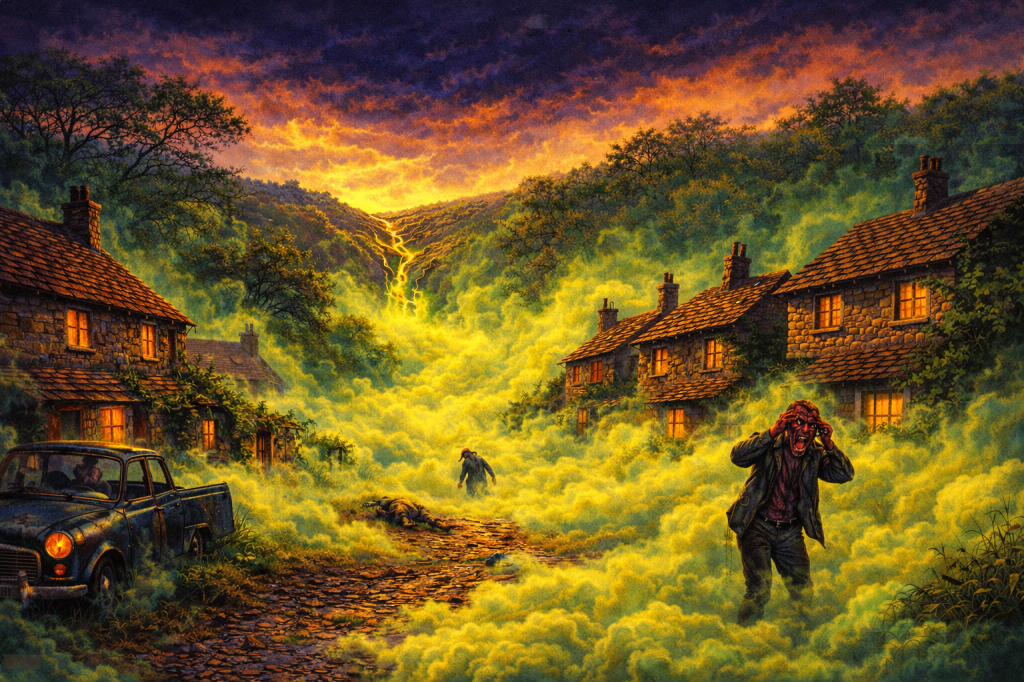
The Fog, Herbert’s second book, is unashamed pulp. It follows John Holman, an everyman who also happens to be the Environmental Department’s maverick cop-equivalent, as he investigates a Ministry of Defence base in rural England. A nearby village straight from a postcard is stricken by an earthquake, which swallows Holman’s car and releases a mysterious fog that turns him insane. Because why not.
Apparently this newly released fog is actually a sentient hate plague, and it immediately makes its way throughout rural England towards London. The country bumpkins caught in its path are also turned rapidly insane and engage in acts of extreme depravity and violence. Which I think is just an excuse for them to stamp out some petty rural grudges (like killing that bint whose petunias won the village flower contest).
Because Holman is Mr. Renegade Hardman Sex-Master, he essentially shrugs off his insanity and goes home to shag his girlfriend. But as Holman is the only one who knows what is going on, ‘natch, it’s up to him and his spunky love interest to investigate before everyone is doooooooooooooooooomed.
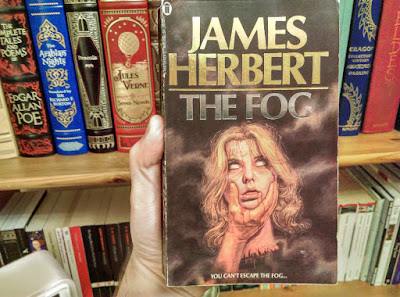
This one is pretty full on – it’s early in Herbert’s career, written when he still had the balls – I think the death count in this one is in the hundred thousands. This includes the mass suicide at Brighton Beach, and the 9/11-style plane crash into a Post Office tower. Look at the front cover of my copy (top image), which features a woman’s severed head. Just try attracting women at a bar when you’re sat reading this thing.
The novel is structured in a way that every couple of chapters we leave Holman and are saddled with some side character. Herbert has this habit of introducing a new character, establishing their backstory, and killing them off within ten pages.
But which is your favourite Seventies stereotype? There’s the gay boarding school teacher (who is a paedo, because he is gay and it’s the Seventies). There’s the black guy who is down and out and can’t hold a job (because he’s black, and it’s the Seventies). There’s the lesbian who is dumped by her partner who got ‘cured’ by a man, because it’s the Seventies. You get the picture.
These interludes serve to pad out the paper-thin story. But honestly, they were my favourite part. Once each of these vignettes were over, I looked forward to reading the next one. The best bit has to be the section with the aforementioned teacher. He and his pupils get caught up in the fog earlier in the story. Later on the pupils get naked during PE class, bum their PE teacher, tie up the paedo teacher, whip him until he gets hard, and then cut his dick off with garden sheers. Yeah…
The Fog is not literature, nor does it aspire to be. The writing reflects this, being mostly functional with the odd fancier word and unusual metaphor thrown in whenever Herbert gets bored. As pulpy horror, however, it excels. Part way through the novel we’re treated to the ridiculous, but obligatory, ‘serious scientist explains the plot for twenty pages’ scene which attempts to add meat to the plot. But how can you add substance to a villain that’s apparently a sentient fog?
And let’s not kid ourselves. Books like this exist so writers like Herbert can craft obsessively detailed scenes of violence. Or sex scenes which make liberal use of phrases like, ‘her entrance’, ‘aroused lubricity’, ‘moist cave’ and…oh Jesus, put it away Herbert.
 Midnight Cinema Junkyard
Leave a comment